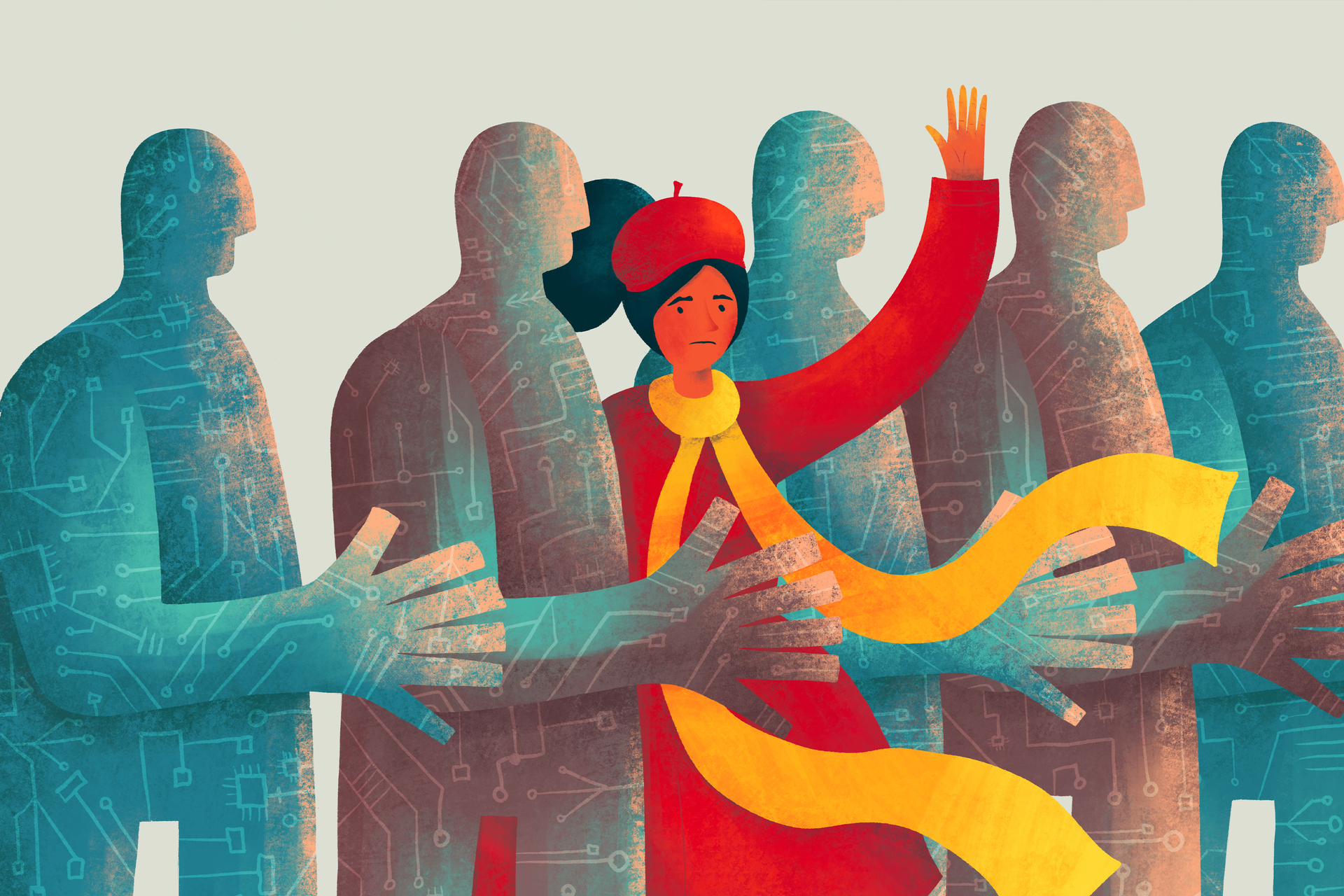
I type my full name into the little grey search box and hit return. It’s March 2025 and, around the world, thousands of authors are doing the exact same thing: checking The Atlantic’s website to see if their writing is part of a vast database of pirated books.
The result is instant, my book Written: How to Keep Writing and Build a Habit That Lasts is on the list. It confirmed what many of us had long suspected, that our published works have been used to train the Large Language Models (LLMs) that power Artificial Intelligence (see appendix Understanding Artificial Intelligence below). Along with our online articles, blogs, social media posts, YouTube videos, the whole history of human creativity had been 'scraped' to teach machines to be more human: without our permission and without credit or payment.
We’ve reached a point where computers are able to perform some of our most human tasks. AI Chatbots can compose our dating app replies, coach us through awkward conversations, even offer comfort when we’re alone. And the impact of AI on writers’ lives has become impossible to ignore. We can see it stealing our words and threatening our livelihoods, even as it promises to improve our productivity and remove our writing struggles. If AI can do the writing for us, what does that mean for those of us who live by words?
Whether we like it or not, AI is already deeply embedded in our lives. It has infiltrated our trusted software, powers our internet searches, observes our messaging apps, and tailors our social feeds. One in three US adults used ChatGPT in 2025 according to the Pew Research Centre, and Professor Ethan Mollick, author of New York Times bestseller Co-Intelligence, reports that 10 per cent of humanity now uses AI weekly.
In the Harvard Business Review, Marc Zao-Sanders explores how people are really using generative AI now, and found the use of AI has expanded beyond technical tasks and productivity to 'decision-making, creativity and emotional support'.
As a professional writing coach, I clearly need to watch my back. The top four functions Zao-Sanders identifies are integral to my role. At number one was therapy support and guidance, followed by ‘organise my life’, find purpose, and enhance learning.
So much for coaching. Generating ideas and creativity were in the top ten too, with both writing student essays and creative writing high in the rankings. AI now helps people craft original stories, poems and online content, and proffers writing prompts, plot ideas, and help with character development.
This is all very worrying for writers. When the Society of Authors consulted its members earlier this year about the impact of AI, the majority of respondents were pessimistic: '57 per cent of writers do not consider their area of creative work to be a sustainable career, and 72 per cent believe that their work opportunities as a creator have been negatively impacted by generative AI'.
Their worries were confirmed by a team led by Kiran Tomlinson at Microsoft in July this year, who analysed 200,000 conversations with Copilot and discovered that the most common activities people asked AI for help with were ‘gathering information and writing'. On a list of 40 occupations deemed most at risk, writers came fifth, with subcategories of technical writers, proofreaders, editors, journalists, and translators especially vulnerable.
And the occupations least at risk? The kinds of hard-graft, hands-on roles that keep healthcare, construction and heavy industry going. In this data-envisioned future humans spend their precious lives removing hazardous waste, tending sick bodies, and preparing them for burial, while the machines produce the words that once gave our life meaning. Author Joanna Maciejewska sums this up in her viral X post: ‘You know what the biggest problem with pushing all-things-AI is? Wrong direction. I want AI to do my laundry and dishes so that I can do art and writing, not for AI to do my art and writing so that I can do my laundry and dishes.’
But are these predictions really what our future holds? The Microsoft research is limited to its dataset, which is a snapshot of past use. By its very nature, AI must work what already exists. It's excellent at recognising patterns but perhaps not so good at imagining possibilities. For that we need human creativity.
I asked award-winning author Naomi Alderman whether we're doomed Her novel The Future revolves around an autonomous AI that supposedly predicts the end of the world, but her current view is less apocalyptic. ‘I have my doubts that AI is a major threat to the livelihoods of writers,' she told me. 'No one can really know what the future holds, but I think it’s only a threat to humans if we allow it to be.’
So that's our creative challenge: How do we coexist with the machines while protecting those aspects of writing that are most human?
The Microsoft research gives us a clue about keeping human writing alive in the age of AI. It divided tasks into two types: those tasks people ask AI for help with, and those they ask AI to perform on their behalf. This got me thinking about the difference between AI helping writers and actually replacing them.
HELP AT A COST
Here's an example of what AI can do. Following the death of my mother this spring, I just couldn’t face writing. It wasn’t a simple creative block, but a nihilistic ‘Why bother?’ I had a newsletter to keep running with my co-author Chris Smith, so I needed to get some words out. Our book was already powering AI as part of the LibGen database, so there was no point in protecting my intellectual property. I uploaded the book to ChatGPT and asked for some ideas for a newsletter.
AI chatbots are trained to please, so it was full of praise for my writing. It then crafted not just one newsletter but a whole series, sharing the best of my stories, along with advice to support my readers. It was astounding. When I couldn't write, AI could give me everything I asked for and more. But it felt weird. There was a hollowness to the writing. Yes, it was all my work told in an uncannily familiar voice, but it wasn’t truly mine.
In the end, I didn’t use any of those AI-generated newsletters. Yes, I needed help, but using AI to write for me would have taken away the reason I write in the first place – which is to forge an authentic human connection with my readers.
What this experience taught me was that my writing block was an important part of my creative process. It might have been uncomfortable, but it was telling me something.
Read Yourself Happy author Daisy Buchanan is a voice I turn to in trying times. She believes writers need to develop a facility for discomfort if they are to produce work of value. She has serious concerns about AI because we can use it to take the friction out of life. ‘We have to allow ourselves to feel sad, angry, confused, annoyed – and to sit with those feelings,' she argues. ‘No-one with a smartphone needs to sit still with themselves for a single second. We resist the stillness, because it’s frightening and unknown. But that’s where the magic lies.’
Writing can often be hard, which is why turning to AI is so tempting. Last week, while working on this very article, I was full of ideas but unable to distil what I really wanted to say. I felt overwhelmed and wished it was easier. I longed to reach for what Ethan Mollick calls the button, he said. ‘When you have a button that produces really good words for you, on demand, you’re just going to do that'. Over and over again.
I can avoid discomfort by outsourcing my creative struggles to AI, but over time that becomes a habit – and I’ll lose the capacity to handle the difficult parts of writing. And for me, as for so many writers, the struggle is often where the best ideas come from. In opting for ease, I deny myself of the opportunities for creativity, growth and development (which just happens to be what my next book is about).
Daisy Buchanan feels ‘utterly furious’ when she hears of writers using AI to bash out a first draft. 'The thing that makes the process rich and interesting for me is writing my terrible first draft by myself, and sifting and working and stirring and making it better.’
Naomi Alderman tried outsourcing a first draft of an article to AI as an experiment, providing it with bullet points of what she wanted to say with the prompt to, ‘write in Naomi Alderman style’. The result was ‘both bad and obvious,’ she says. Worse, it blunted her inspiration. 'I found it hard to recover the original interesting, unusual, or unique idea or feeling that I wanted to capture'.
CREATIVE STUNTING
This sense of creative stunting comes up as a major issue when writers are asked about AI. The Society of Authors reports that writers were concerned about ‘creative atrophy’ and ‘people losing the ability to think critically’. Children’s author Charlotte Guillain agrees. Her forthcoming title, Bella Built a Robot explores the themes of AI. She tells me it can help humanity in many ways. ‘But the message is also that human creativity can never be replaced.’ As a writer, Guillain worries about ‘the effect on my brain of delegating all creative thought to AI. I don’t want it to become a habit but rather be an aid I can turn to in specific situations.’
Translating the ideas in my head into words on the page, forces me to confront what I don’t know. As I write, the gaps in my knowledge are exposed and that feels difficult – but essential. I agree with Flaubert, who said 'the art of writing is the art of discovering what you believe'.
Naomi Alderman puts it like this: ‘My big advice is ABSOLUTELY DO NOT LET THE AI WRITE FOR YOU. If you’re a writer, you think by writing. And thinking is the job. If you let your brain get used to the idea that there’s a shortcut, I really think it will get progressively harder to come up with new ideas, thoughts and observations. The muscles just atrophy.’
So what is it like to use AI as a helper rather than letting it replace us?
I’ve always had help with my writing tasks. Over the years, my tools have evolved from notetaking during interviews, to Dictaphone and transcription, and now AI that both records interviews and transcribes them instantly. This productivity gain has saved me hours of time and thousands of pounds – and offers no existential threat whatsoever.
A Substack survey of 2,000 writers in July (The Substack AI Report by Arielle Swedback) found that 45 per cent use it in their posts: not for the writing itself, but for summarising research documents, proofreading, and helping with SEO and marketing. Substack writers aged over 45 were more likely to use AI than younger writers, and men more than women (55 vs 38 per cent). Writers already using AI tended to be more optimistic about its possibilities it offers; those who haven’t used it feared harm and disruption.
In my role as a writing coach, many of my clients talk about the benefits of AI: for an academic for whom English is a second language, for a memoirist undergoing cancer treatment, and a novelist who might otherwise have given up. Fellow coach and author Katherine Clements has found the same. ‘I haven’t encountered anyone using it for the actual writing,’ she told me. 'Most use it for writing-adjacent tasks, such as creating a synopsis and query letters.'
We agree there is an argument to be made for delegating some writing tasks to AI – I've found it useful for polishing my author bio and reworking a workshop blurb. But could it write a poem?
Novelist and poet Ros Barber, who is a former computer programmer, asked it to write a sonnet. ‘It was terrible; I felt relieved,’ she told me. But when she tried it later with a class of creative writing students at university the result was far more passable. She initially saw this as a threat, but has since become more pragmatic, reasoning that 'writers who doggedly ignore AI, and don’t make use of some of its advantages, will be obliterated by those who do'.
After being made redundant, Barber began experimenting with AI chatbot Claude for time-consuming and tedious tasks. It has several uses: as a research assistant, a series of prompts to AI can identify what she’s after more quickly and accurately than Google. As an editor, she relies on AI for ‘a quick, knowledgeable second opinion regarding any mistakes I might be missing, points where the flow is off, or somewhere where I might be unclear'.
MARKETING WIZARD
But it really hits the mark with marketing, a bugbear for many writers. ‘Once I’d trained Claude on my writing, it was able to tell me what people are responding to'. This made it easier for her to create marketing emails, extract short shareable pieces for social media, and produce a 100-word bio for a specific event. AI has supported Barber to go freelance and earn an income in a financially precarious time. She explains, 'It reduces my admin time, buying me more time to do what I love and am good at: the artform itself.’
For Dr Elizabeth Blakelock AI has proved transformative. As a disabled solo parent in a full-time role, she juggles work alongside endless life admin and being a disability advocate. 'For those of us who face barriers when we try to write, AI offers a way to make space for creativity in our demanding lives,’ she says. ‘And I think we can use AI in our writing with integrity and intention.’
She uses it as a thesaurus, grammarian, and Dictaphone, and to help her fit creative writing into her routine. It helps her ‘reach through the brain fog of perimenopause and pain medication to find the word that’s on the tip of my tongue. It takes a rambling first draft of word-vomit and reshapes it into structured prose.'
These examples show how genuinely helpful AI can be, but there is a downside. The tools that make writing easier for some also make it effortless for everyone. Its productivity has consequences, and we are drowning in 'AI slop'.
Science of Storytelling author Will Storr spotted something interesting about some texts on the Substack platform. He noticed that certain writers shared a distinctive but strangely generic style he calls 'impersonal universal'. Characterised as ‘a hammy actor doing wise poetess on the mountaintop’ Storr realised these weren’t human-generated posts at all, but AI’s imitation of wisdom.
This type of low-quality content floods online platforms. Yet, people seem to love it – the posts often go viral, garnering thousands of likes, shares and comments. Storr believes a Rubicon has been crossed, with AI genuinely touching human hearts. Should we be worried? ‘You shouldn’t be surprised if it moves you, any more than you should be surprised that a Mars Bar tastes good,’ he told me. AI writing is to good literature what ultra-processes food is to organic produce: delicious and moreish, but ultimately catastrophic for our health. As Daisy Buchanan says: 'AI is replicating something we're all familiar with, but it's not nourishing. We need nourishment.'
HUMAN CONNECTION
There is another issue here: the sense that we are being cheated out of an authentic human connection. Storr believes that, with experience, we can easily develop an ear for AI. ‘When we hear it, we should avoid that writer. It is a betrayal of the contract between writer and reader.’
Literary agent Anna Power of Johnson & Alcock agrees. ‘It’s obvious where AI is being used,’ she says, because those submissions have a polish and flatness that lacks what she calls soul. ‘Happily, we’re still easily able to identify and celebrate human originality.’ Power believes that human creativity can’t be replicated and makes an impassioned case for writers to keep submitting their work – it's a moral imperative to avoid ‘a race to the bottom,’ she says.
She values an original voice, which is engaging to read precisely because it is unique to the writer, and not straining to sound like someone else. As Storr told me, ‘AI is all remix, so to get ahead of it we need to focus on what our own unique voice and experience can add to our writing.’
The most effective children’s writers do something no machine can. Emma Drage, senior commissioning editor at OUP, told me her authors ‘are able to explore the world from a child’s perspective’. Their human understanding enables them to create ‘stories that profoundly resonate with young readers, help them to explore what kind of person they want to be and how to relate to the world around them. This requires empathy, emotional depth, and an ability to draw on lived experiences.’ These are things that no algorithm, however intelligent, can experience.
Professor of writing Julia Bell argues that in the age of AI live literature will grow in importance, because readers will increasingly want to see and hear the people producing the texts that they love, to be reassured that they are being produced by a living and breathing, complex and flawed, organic human being. For Bell, creative writing is going to be an even more necessary skill in the future. ‘The machine cannot feel emotion, or live as a sensory being in the world.’
The rapid rise of AI and the proliferation of AI slop has brought us to a crossroads. We no longer need to engage in the uncomfortable, messy and slow process of struggling with our writing. But the difficulty of writing isn’t a productivity problem and AI isn’t the solution. We have a choice in how we use these tools, if indeed we use them at all.
When I chose not to use those AI generated newsletters, I wasn’t choosing difficulty for its own sake. I was choosing to offer my readers something AI cannot: an authentic connection between a writer and a reader.
Ros Barber summed it up like this: ‘Those of us who continue to generate original writing, and really develop our skills at transmitting emotion, may end up with an advantage in a textual landscape that will look increasingly beige.’
This is the choice before us. We might be tempted to let AI do the work for us, but that decision robs us of something fundamental and deeply human. The creative process is full of friction and uncertainty, but that’s what leads to genuine insight and originality in the work we produce.
BEC EVANS is an author and coach known for turning complex ideas about creativity into practical tools for writers. A former publishing head of innovation and Arvon centre director, she runs The Written Academy and coaches on Mslexia’s writing schools and Diary & Planner. She writes Breakthroughs & Blocks on Substack and co-wrote Written: How to Keep Writing and Build a Habit That Lasts.