I often take my writing for a walk.
A short story I took to Brighton’s Stanmer Park gained a fresh narrator after a sunny Sunday under a favourite tree. A coastal stomp became the rhythm for a new piece of poetry; I found myself speaking it aloud, over and over, as a way to remember my words until I got home. I’d not taken a phone or paper to capture the impromptu poem that unexpectedly emerged.
As my pace quickened, I thought of Elizabeth Gilbert’s conversation with the poet Ruth Stone in Gilbert’s book Big Magic. Stone recollected running ‘like hell’ through fields as a child, back to the house to write a poem down, sometimes just catching it ‘by the tail’, before it went ‘galloping away across the earth’.
Stone was almost 90 when she and Gilbert had this conversation, and yet I can still feel the physicality of her childhood memory in my own body. I’ve long suspected writing isn’t a quiet deskbound pursuit.
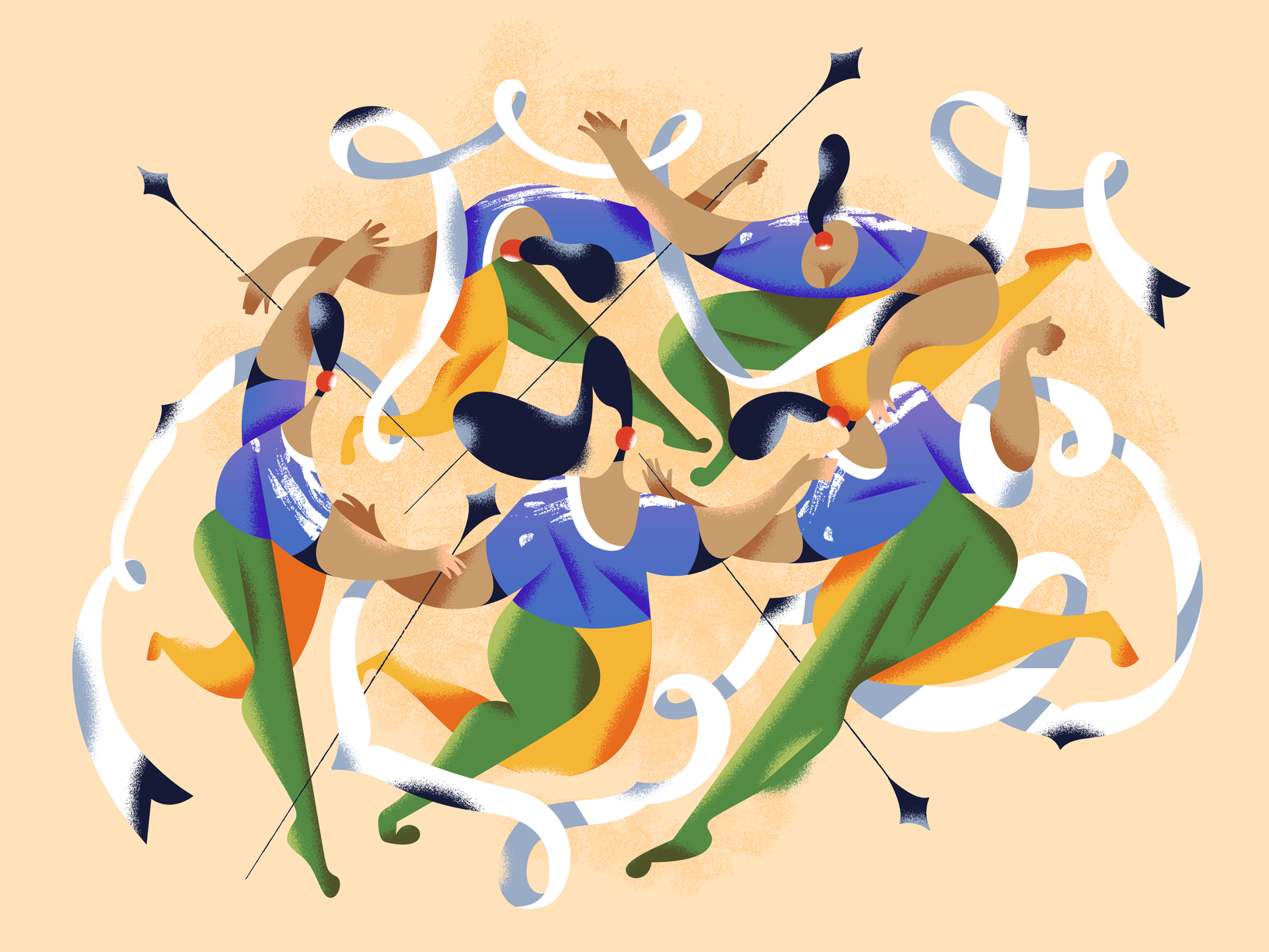
When a walk or run fails to get my words flowing, I up the ante and invite my writing to dance with me.
For around four years now, I’ve been a regular within the ecstatic dance community, participating in sober, mindful movement: barefooted and communicating without talking. I felt daunted at first – I’m clumsy, not at all sporty, and the concept of a dance class where nobody shows you the steps was scary – but it also felt so much better than being trapped at a desk. So I moved towards my fear, one shoeless foot at a time. Before long I was, wordlessly, inviting strangers to dance and enjoy the language of physical movement, improvisation and, occasionally, contact.
These conscious, sober spaces are somewhat ceremonial, often offering cacao and a spiritual altar. There might be oracle cards, candles, flowers, art. As the music moves through different energies and moods, you can whoop or cry, or just lie and feel the rhythm of strangers’ bare feet around your busy brain.
When I dance, ideas flow. This moving meditation always entices me in a way cross-legged om-ing never did.
Ecstatic Dance Brighton’s founder, Anna-Lisa Drew, took a course in how to DJ for the nervous system as part of her training. Drew’s background is in Taoist movement, wellbeing, and art therapy, and I especially enjoy her curated outdoor dances, on beaches and in woodland. Dancing with sand or warm, soft earth under my feet feels transcendent. I’m also a huge fan of Sunday morning dances at The Baths (Hackney Wick) held by Ecstatic Dance UK. Delightfully packed and high energy, there are often live musicians or vocalists alongside the DJs.
I began wondering if dancing could unlock other stuck writers too, and invited Anny Webb, who uses the principles of ‘Movement Is Medicine’ (MIM), to run sessions at two retreats for me: one in Brighton, the other in the famous book town of Hay-on-Wye.
Movement Is Medicine (MIM) is a practice created and founded by Emma Marshall, whose self-published book Music Is Medicine explains her powerful personal journey and the quest for healing that led her to create MIM HQ. In some ways MIM is similar to ecstatic dance, but it also incorporates other practices such as EFT (Emotional Freedom Technique) tapping, and has even more of a focus on nervous system regulation.
The Brighton group got involved immediately, dancing wildly with us in a theatre above a pub on the edge of Kemptown. Our poetry facilitator joined in too, and we flowed into their workshop with openness and warmth on an otherwise cold January day last year. One of the participants told me the hour of dancing felt ‘better than a year of therapy’.
Another writer, Becky Slack, was initially sceptical before she tried the MIM class last summer in Hay. Slack runs Agenda, a communications agency, and lives in Ghent, Belgium. She’s currently writing her first novel.
‘I enjoyed it more than I thought I would,’ Slack admits. ‘I initially thought I’d feel a bit stupid. I was a bit self-conscious. But I’d told myself I was going to do everything on the writers’ retreat, enjoy
the whole process and see what happened. I went for it. And I really loved it. I didn’t feel silly; I actually felt quite free, and unblocked.’
Slack explained she’d felt blocked as a writer for the last few years: ‘Pre-Covid I was writing every single day; I got 33,000 words down. And then Covid happened and it was like my creative energy had completely disappeared. I don’t know whether it was the anxiety of being in lockdown, but something kind of got stuck. And I hadn’t really written anything until I came on your retreat.’
‘I wrote so much while I was there, and I’ve continued writing since. Not every day, but I’ve been writing much more. I really feel the retreat was the trigger for releasing that kind of blockage.’
‘Moving in front of people can be vulnerable,’ Anny Webb reminds me. She talks about being able to trust yourself enough to let go; for her, dancing was a way to get back in touch with her own voice.
‘I’ve lived with an overactive brain all my life,’ Webb explains. ‘It would piss me off when people talked about “intuition”, because I didn’t even know what I wanted to order at the bar on a night out. I couldn’t get to that place of being still enough to trust my own voice, either creatively or in relationships. But through physical expression, it’s like a gateway opening. I can enjoy moments of stillness, I can journal. Physically writing felt elusive before.’
While I was living in Brighton, I began to perform spoken word poetry at open mic nights. I’d seen Kae Tempest perform at the Brighton Dome, and his support act was the much-loved Sussex-based poet Subira Joy. A few months later I performed my first ever open mic poem at The Actors in Brighton. By coincidence, Joy was the compère. My heart was beating out of my chest with nerves, because I knew how accomplished Joy is as a poet and performer. I cried during my own performance, but I’m proud that I did it. I returned week after week for around a year, before eventually returning to Hay and performing poetry there, on home turf at The Globe.
I asked Joy for their thoughts about the connection between movement and writing. ‘As a performer, movement and words exist both as languages I can pull from to communicate to an audience,’ said Joy. ‘Sometimes where words fail me, movement is there. Sometimes writer’s block manifests so physically that I have to get up and shake my body to get ideas moving again.
‘In my show Kill The Cop Inside Your Head, I explore ancestral technologies to find ways to resist internal policing. I use twerking as one of my weapons of choice! Twerking is ancestral technology, with multiple uses, one of them being to regulate a nervous system stuck in a freeze response, as so many marginalised people’s nervous systems are.’
‘I’m really interested in dance as therapeutic, and in this way, as a tool for decolonial resistance.’
I met author and creative writing tutor Sarah Star, who runs writing workshops designed along the principles of ecstatic dance, while I was dancing in Brilley, Herefordshire. She’s designed ‘Ecstatic Writing’ sessions to help individuals connect more deeply with their creative flow.
‘When I’m dancing I am wholly present in the moment,’ says Star. ‘I become focused entirely on responding to the music in the here-and-now, following my impulse to move. It is a kind of flow state that’s similar to the one I aim for when I’m writing. I don’t know “where” the words or ideas are coming from, but if I can allow myself to just write, and be present, the movement of ideas and the narrative I’m creating is like a spontaneous dance.’
And so it seems that all this barefoot expressive freedom eventually leads us back to a desk of some sort, and to the words, dancing, on the page. But as we type, we can remember we are creatures who inhabit bodies that like to move.
‘For me, a lot of writing a book is sitting at my desk getting words down. I think there’s a very old quote about creativity being a small percentage of inspiration and a large one of perspiration, and for me that definitely applies,’ says author Eva Glyn. ‘If I didn’t do Pilates, I simply couldn’t do the “perspiration” part of creativity as effectively, because to spend any length of time at my desk, my back needs to be healthy. It’s also a joyful escape from the office. Time to breathe (properly!) and focus on my own wellbeing.’
And any time the words won’t come, dance is there to hold us and to bring us back. ‘I think dance kept the creative spirit strong even when I couldn’t write,’ concludes author S L Rosewarne, who kept up ballet classes even when post-viral fatigue meant she couldn’t write for months. ‘Writing has always been so much part of me that not being able to felt very odd,’ says Rosewarne. ‘But dance fulfilled the creative urge and helped me believe that I’d be able to write again when I was better.’ ■
Try this
Choose a song you enjoy, ideally without many words: we’ll be focusing on the rhythm and beat, not the lyrics.
- Move to the song, in a way that feels good (and safe for you and your body). Whether that’s sitting and swaying or a more energetic dance on your feet, it’s up to you. You might want to close your eyes.
- For the duration of the song (three to four minutes), allow your body to move as it wants to. If a thought comes up, try to let it pass, focusing instead on feeling into your body, or on your breath.
- There’s no need to think about writing as you dance. But when the song ends, move gently to your desk, or simply open your laptop or notebook wherever you are.
- Now either journal or free-write or return to a writing project you have on the go.
- Allow yourself to be absorbed by writing. Set a timer if that feels helpful, it could be for five minutes or 25 minutes. Don’t overthink it.
- Reflect afterwards on whether your writing felt better/worse or the same as usual. Did your brief dance/movement session improve your flow?
Helen Jane Campbell is an accredited and experienced life and business coach living near Hay-on-Wye. Her book Founders, Freelancers & Rebels: How To Thrive As An Independent Creative is published by Business Expert Press.